


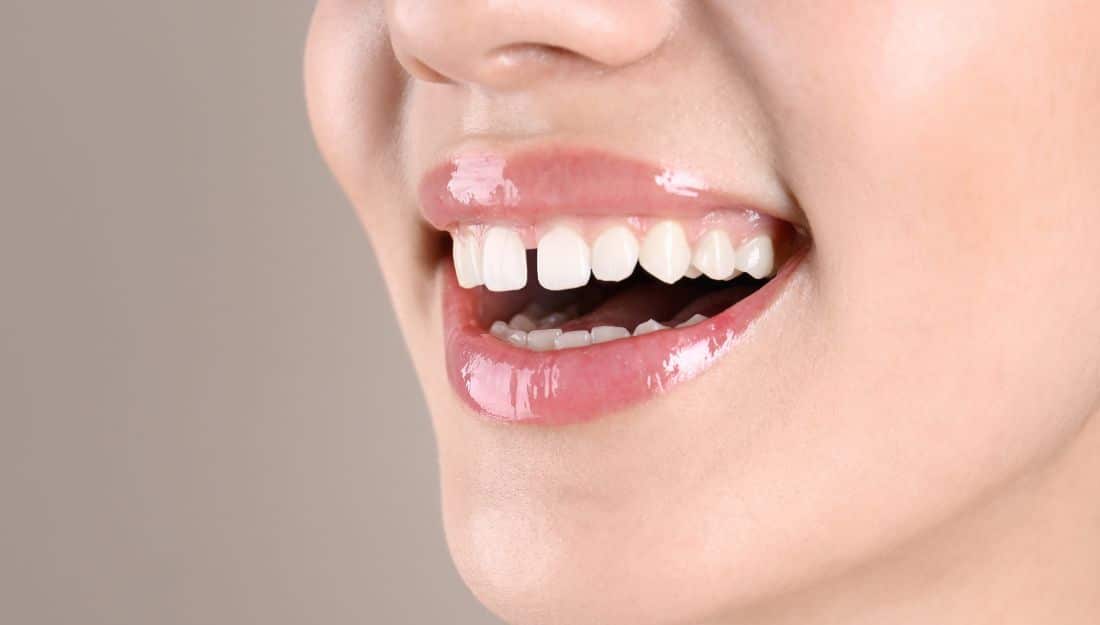
Some gaps are charming. Others are the reason a person has spent fifteen years smiling with their lips closed. And a few, quietly, are a sign that something structural is shifting.
Spacing between teeth is one of those findings where the right response genuinely depends on the situation. A gap between a seven-year-old’s front teeth and a gap that opened up in a fifty-year-old’s lower arch last spring are not the same event, even though they look similar. This is a guide to telling them apart, and to knowing which ones are worth bringing to an appointment.
Why Spaces Form
Gaps develop for a handful of reasons, and identifying the cause shapes everything that follows.
- Tooth size relative to jaw size. If the teeth are narrower than the arch they sit in, spacing is the natural result. This is inherited and it’s the most common cause of the classic gap between the two upper front teeth.
- A thick or low frenum. The band of tissue connecting the upper lip to the gum sometimes extends down between the front teeth and holds them apart.
- Normal childhood development. Baby teeth are smaller than the permanent teeth replacing them, and spacing in a young child’s smile is usually a good sign rather than a worrying one.
- A missing tooth. When a tooth is lost and not replaced, the teeth on either side drift toward the opening and the tooth above or below can drop into it. Spaces then open elsewhere in the arch.
- Gum disease. As the bone supporting teeth is lost, teeth loosen and migrate. New gaps appearing in an adult mouth are one of the more reliable warning signs of periodontal disease.
- Habits and pressure. Prolonged thumb sucking in children, or persistent tongue thrusting at any age, applies steady force that pushes front teeth forward and apart.
Gaps That Usually Aren’t a Problem
It’s worth naming these clearly, because a fair number of parents worry about spacing that’s doing exactly what it should.
Spacing between a young child’s baby teeth is normal and often desirable. Those gaps are the room the larger permanent teeth will need. A four-year-old with tightly packed baby teeth is more likely to face crowding later than one with visible spaces.
A gap between the upper front teeth in a child who’s still losing baby teeth frequently closes on its own as the canines come in and push the front teeth together. Dentists sometimes call this stage an ugly duckling phase, which is unkind but descriptive. It resolves in most cases without intervention.
And in an adult with healthy gums, stable bone, and a gap that’s looked identical for twenty years, spacing is a cosmetic question and nothing more. If it doesn’t bother you, there’s no clinical obligation to close it.
The Checklist: Signs a Gap Deserves a Look
These are the ones worth an appointment rather than a wait-and-see approach.
- The gap is new. Spacing that wasn’t there a year ago means teeth have moved, and in adults that movement has a cause. This is the single strongest signal on the list.
- It’s widening. A gap that keeps growing points to an ongoing process rather than a settled anatomy.
- Food packs into it constantly. Not the occasional seed, but a space that traps food at every meal and needs picking out afterward. Trapped debris against gum tissue causes inflammation, and inflammation in that spot accelerates the problem.
- The gums around it bleed or look puffy. Spacing plus bleeding gums is a combination that shouldn’t wait.
- A tooth near the gap feels loose. Mobility in an adult tooth is never a normal finding.
- It opened after a tooth was lost. Drifting begins within months of an extraction and gets harder to reverse the longer it continues.
- Speech has changed. Front spacing sometimes produces a whistle or a lisp on s and th sounds.
- Your bite feels different. Teeth that have moved change how the upper and lower arches meet, and that shows up as a bite that suddenly feels off.
- In a child, the permanent canines have come in and the gap hasn’t closed. That’s the point where spacing stops being a phase.
- It bothers you. A gap you’ve disliked for years and hide in photographs is a legitimate reason to ask about options, with no additional justification required.
What Happens at the Appointment
The evaluation is more about cause than about the gap itself. Your dentist will check the health of the gums and bone around the spacing, since periodontal disease and drifting teeth are the findings that change the plan most. X-rays show the bone level and the position of the roots. For children, they show where the unerupted permanent teeth are sitting and whether there’s room for them.
Beyond that, the exam looks at how your teeth come together, whether any teeth are missing or have drifted, and whether a frenum or a habit is contributing.
That assessment determines the path. A gap caused by gum disease gets the disease treated first. A gap from a missing tooth is usually a conversation about replacement rather than about closing the space. A gap that’s purely a matter of tooth size and position is where the options open up.
The Range of Options
Closing spaces generally falls into two categories, and which one fits depends on the size of the gap and how the bite functions.
Moving the teeth. Clear aligner treatment with Invisalign physically repositions teeth to close spacing. This is the approach when there are multiple gaps, when the bite needs correcting alongside the spacing, or when the gap is wide enough that filling it would leave teeth looking too broad.
Reshaping the teeth. Bonding adds tooth-colored material to the sides of the teeth bordering the gap, and veneers cover the front surfaces entirely. Both close space by making teeth wider rather than by moving them, which suits smaller gaps and situations where the bite is already sound.
Where a tooth is missing, the conversation shifts to replacement, and where a frenum is holding teeth apart, a minor procedure to release it typically comes before anything else so the correction holds.
Bringing It Up in Yorkville
The distinction that matters most is whether a gap is stable or changing. Stable spacing you’ve lived with comfortably is a cosmetic decision on your own timeline. Spacing that’s new, growing, trapping food, or accompanied by bleeding gums is your mouth reporting something, and those signs respond much better to early attention than to late attention.
Moss Family Dental sees patients of every age in Yorkville, from parents wondering whether a child’s front gap will close on its own to adults who’ve noticed their lower teeth aren’t sitting where they used to. If something about the spacing in your smile has changed, or has simply bothered you long enough, we’re glad to take a look and tell you plainly which category it falls into.